
On Thursday, Sept. 25, at 5:30 p.m., an unofficial student organization, the “Jewish Bund,” held a vigil for those killed in Palestine, Iran, Yemen and Lebanon.
The event opened with a coffin walk, an event for which the group has become well known. When asked about the message behind this display, an organizer for the Bund, who wished to be referred to as Moshe, stated, “I don’t want this to be interpreted kind of perversely, but the coffin is the size of a child’s coffin.” Moshe expanded on why they chose to make the coffin child-sized, invoking the fact that children in Gaza have been the most affected by the war, noting that, “it is proportionate to the population of Gaza, which is predominantly young, under the age of 18.” They continued, “Often they don’t get coffins, right, they’re buried in mass graves … so, to bring a coffin that is child-size is a statement about what is going on a world away.”
Along with the coffin, they carried a variety of banners into the SCC atrium. One read “New Year, No Genocide,” another said “Stop Supporting Genocide,” and the final was written in Yiddish and translates to “The Bund.” The final banner, according to Moshe, is meant to resemble the historical banner of the namesake of the Brandeis Bund.
At the beginning of the event, a group of around 20 students in medical face masks gathered in an arch around the stairs. The organizers of the event stood on the slightly elevated platform and welcomed attendees, offering face masks to anyone who hadn’t brought their own. Passersby stood back and passively watched the events without the commotion that is often associated with on-campus protests.
The vigil continued with a series of four speeches — three given by organizers in attendance and the final written by someone who couldn’t attend, read out by someone else. All four speeches centered around the Jewish High Holidays (Rosh Hashanah and Yom Kippur). When asked about the timing of the event, Moshe stated, “… we wanted to highlight the incongruities and contradictions in the American Jewish community at large. Whereas we are all celebrating the Jewish New Year, there is a genocide being perpetrated in our name. We think it’s disgusting. We think it’s unconscionable. We think it is all sorts of criminal; it’s a crime against humanity: legally, morally, politically.”
Speech one focused on an alleged apathy within both students and members of the administration, specifically stating, “We have a campus that is apathetic to violence.” The speech continued with a general “call to action.” When asked to clarify what action they were hoping to elicit, Moshe stated, “Really, I think the focus of this group this year, and I think we will sort of coalesce around this adapted mission, is more to raise consciousness, raise the political consciousness of people and bring new students in then necessarily encourage against the university or against people of the university.” They continued, “To be clear, we have never encouraged direct action against university students, merely brought attention to crimes of war that have been committed by university students and … tacit violations of our right to free speech” and “I think that when we highlight a call to action, it is a call for people to [do] the baseline of any political work … to be educated and to be sharp about the issues that you want to effect change in.”
The second speech seemed to continue the line started in speech one. However, the rhetoric expanded to include the need for students and administrators to resist “Fascist America,” including President Trump and ICE. The speech went on to criticize the administration’s suppression of the Bund in the past. The speech ended with a call for Zionists to rethink their positions: “We insist this is happening.”
Speeches three and four followed very similar arguments focused on the actions of Israel in the West Bank. Both these speeches and the event as a whole referred to the actions of Israel as “genocide” and “apartheid.” Speech number three ended with the declaration, “Never again for anyone.”
Speaker number one took the stage once again after speech four concluded. At this point, focus turned squarely on the administration. The speaker proclaimed, “This campus will not protect us unless we make it,” and asked the crowd, “Who pays Brandeis’ bills?”
Focus then shifted to talk about the Warsaw Ghetto Uprising, an uprising of the Jewish people trapped within the Warsaw Ghetto before the Nazis forced them into extermination camps. Out of this historical event came a “song of armed resistance,” Zog Nit Keynmol (Never Say). This section of the speech centered on the Bund’s alleged comparison of the Ghettos of WWII to the treatment of Palestinians. However, some of the claims made by the speaker were not without direct accusations: “In certain ways, the Zionists have surpassed the Fascist Nazis.”
At the end of the speeches, the organizers called for attendees to look at the sheet they were handed as they arrived at the event. On the paper were the lyrics to Zog Nit Keynmol in both English and Hebrew. The organizers then asked participants to sing the song, first in Hebrew and then in English.
Audience participation continued with 14 different chants, where the organizers would yell part of a chant and the audience would yell it back. Some of these chants included, “Free, free Palestine,” “Israel bombs, Brandeis pays, how many kids did you kill today,” “It is right to rebel, Israel go to hell” and “Stop the killing, stop the slaughter, Gaza has no food or water.”
The response to the vigil from both students and administration was restrained. No counterprotesters showed up at the event. When asked about the lack of response from opposing students, Moshe stated, “Yeah, it’s nice because the idea of staging a counter-protest at a vigil, which is just meant to honor lives that have been taken by the Israeli state, to have a counter-protest at an event like this is very silly,” and they continued, “If we were here saying that Zionists have to leave this university, then I would absolutely say stage a protest. You have a place here. You are here. Just as Israel exists, Zionists exist on campus. I am not here to encourage violence against anyone.”
Members of the administration, including Stewart Uretsky, Executive Vice President for Finance and Administration, and Andrea Dine, Vice President of Student Affairs, stood back in high-visibility vests. They didn’t interfere with the vigil, but made their presence known. Moshe stated, about the administrators’ attendance, “I understand them being here supposedly to sort of increase the safety of the group. On the other hand, I question if they are here with good faith. I was handed a sheet with an email that I didn’t have the time to read today because I was too busy in class and getting ready for this event. But I was sent the email the day of the event. So, it seems a little funny that I would get an email warning me that this event is supposedly in violation of student conduct and the student handbook, even though we are gathering at a common space on campus as an unregistered student group. And we’re not violent.”
The Bund continues to remain active on campus and members have stated they have plans to continue gathering for the foreseeable future.
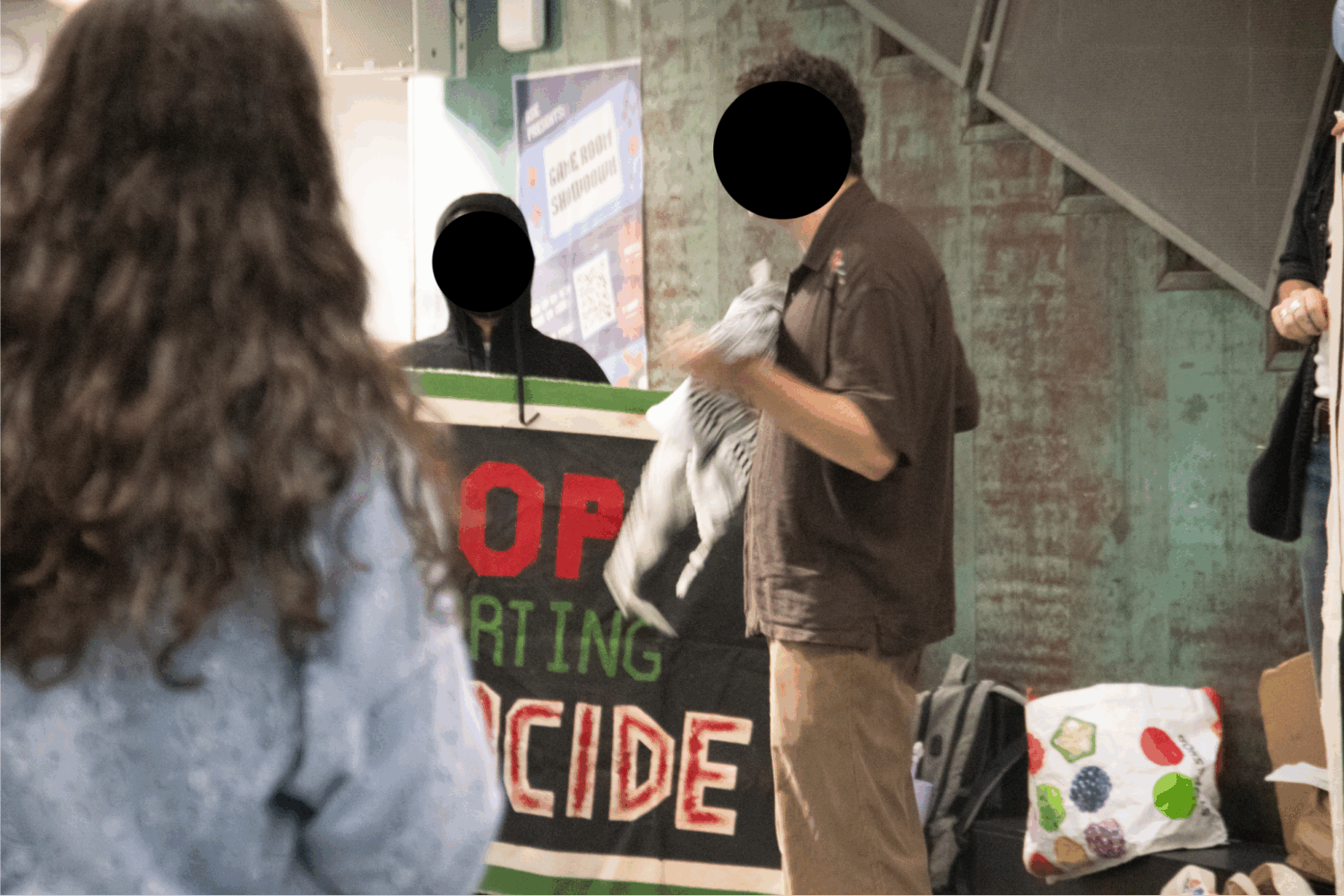
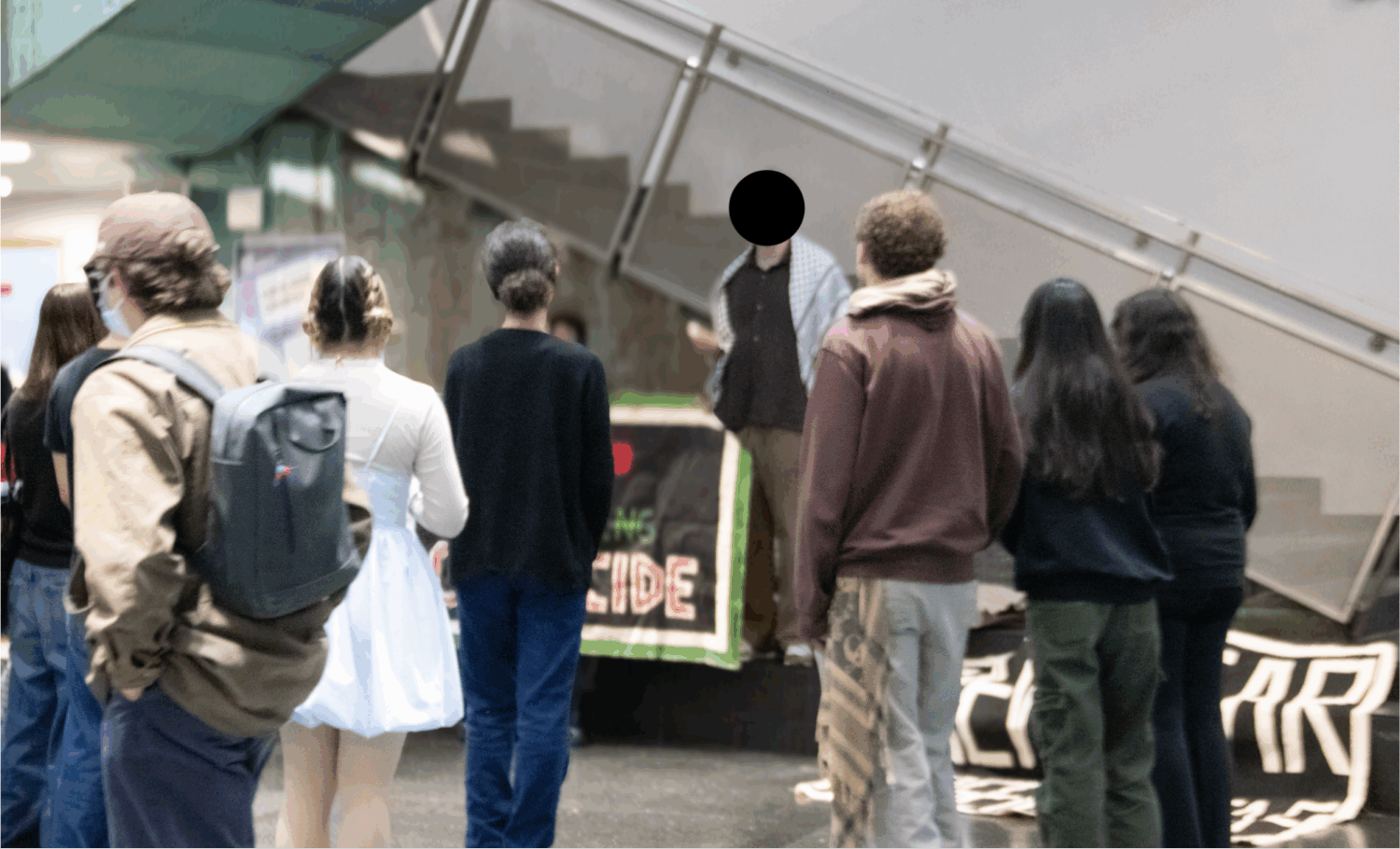
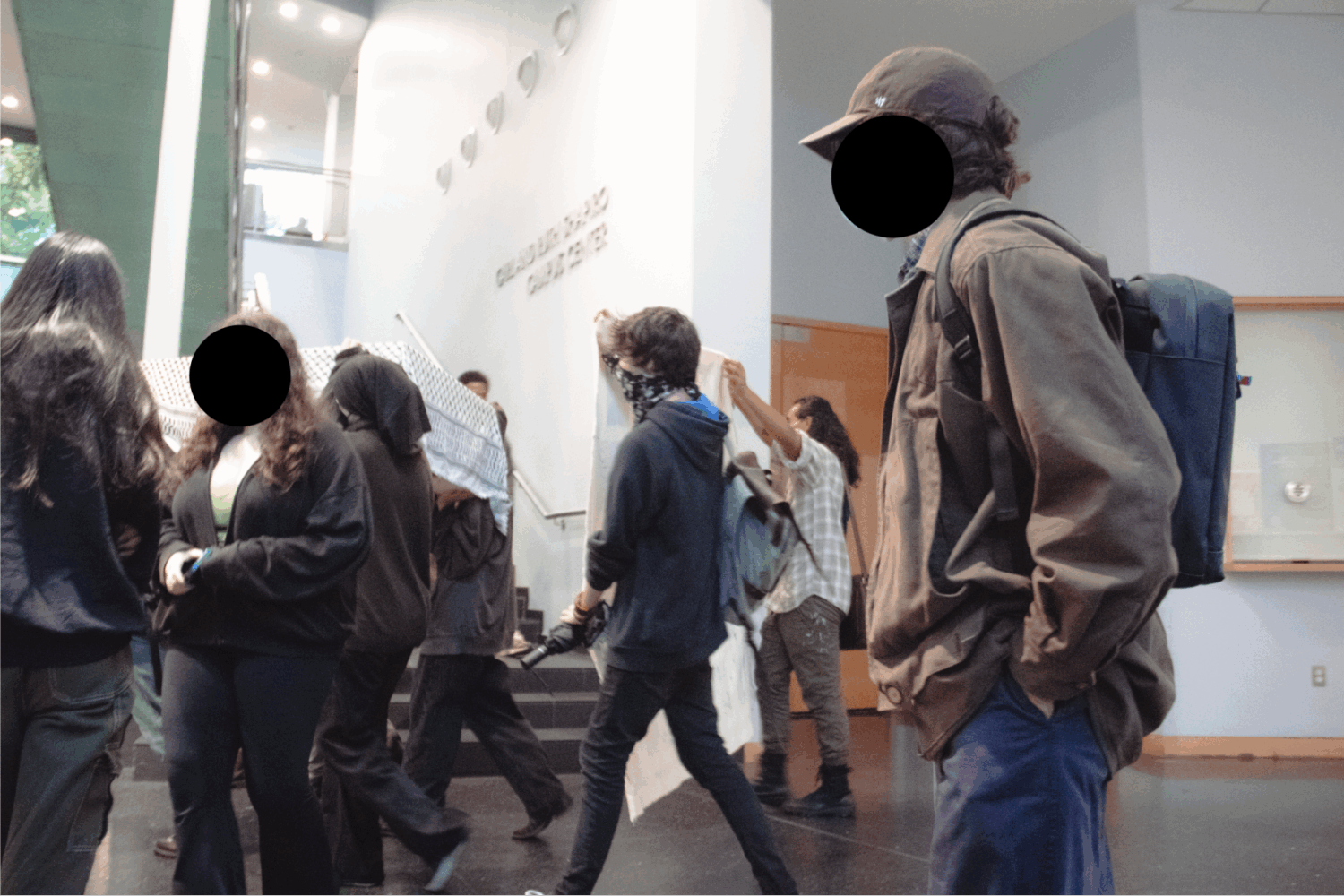
Photo Credit: Desiree Hernandez, Editor
