
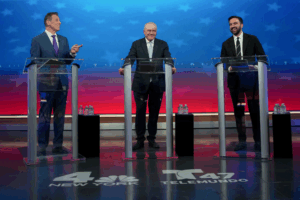
Everyone has seen clips of the recent New York Mayoral debate, or at least has heard about it; if you haven’t, I’m sorry about the coma. Now, this debate has had the far-reaching effect of giving people funny lines to quote and more ammunition to hate on Andrew Cuomo; beyond that, the actual political effects of the debate are slim. This truth is evident in the fact that the debate was watched by so many outside of New York City. This election was already on the national stage, with the opinions and policies of the candidates cemented or never to be acknowledged. For me, an Arizona resident who has never even been to the state of New York, watching this debate is contradictory to the presumed goal of political debates: to change how people will vote.
When looking at the polling data from a few weeks before the 2025 Mayoral Debate and the data from a few days after, this idea becomes clearer. According to Quinnipiac University’s Oct. 9 and Oct. 29 polls, Zohran Mamdani only gained three percentage points (from 43% to 46%), and Andrew Cuomo’s share was exactly the same (33%) between the two dates. While three percent of New York City isn’t something to scoff at, it isn’t the energy one might’ve expected after the response to the debate.
There are an infinite number of problems with how political debates are run currently, from them being run by for-profit corporations to the lack of hard-hitting questions, but there are two problems that form a wall against progress: the timing and modern political culture.
The New York Mayoral Debate was held on Oct. 16, 2025, barely a month before the date of the election. For other countries that treat elections as a once-a-year activity and not a 24/7 bloodsport, that might seem like a perfect amount of distance between the debate and the election. However, American politicians often begin their campaigns a year or more prior to the election. Zohran Mamdani announced his campaign on Oct. 24, 2024; Cutis Sliwa joined him on Feb. 13, 2025; Andrew Cuomo joined the race late on March 1, 2025. By the time the debate came around, most New Yorkers, and Americans broadly, knew who Cuomo and Mamdani were and what their policy agendas were or, in Cuomo’s case, weren’t.
Which leads us to our second problem. Elections now aren’t as simple as putting your name on a ballot, going door to door asking for votes, and maybe making a few buttons. They have become multi-million dollar multi-media productions. There are ads on buses and billboards, Twitter and Instagram, TikTok and Facebook, in the mail and shoved into your door. There is no escaping knowing who these politicians are and what they want you to believe they stand for. Most people know which candidate they are voting for months before the election takes place. A recent study from the Harvard Kennedy School showed that the disastrous 2024 Trump-Biden debate, a moment widely regarded as marking the end of Joseph Biden’s presidential run, didn’t have an impact on voters’ likelihood to vote for him.
Now, you might be thinking, what about undecided votes, aren’t debates meant for them? And you would be right in thinking that; political debates are often conceptualized as spaces for undecided voters to hear all of the candidates and finally decide who to support. There are two problems with this idea: there aren’t that many undecided voters and undecided voters aren’t the people watching political debates.
At the time of the first poll referenced above, Oct. 9, only 3% of voters were undecided, a number of voters that couldn’t have altered the election results. Looking at other polls from around the same time, the pattern holds; there aren’t enough undecided voters by debate day for what is said during the debate to have an impact.
Now you might be going, other elections have much larger numbers of undecided voters, wouldn’t debates help in those areas? That’s a great line of reasoning if you forget one crucial piece of information: politically inactive people, like undecided voters, don’t watch debates. While I couldn’t find data for the exact percentage of debate viewers who were registered New York voters, there is information that can be surmised from the data available. 2.3 million people tuned in for the debate. This is despite the fact that only 2 million voters participated in the election. If one assumes that all 2 million voters watched the debate, that means only a few hundred thousand non-voters tuned in. Based on the discussions surrounding the debate, one can surmise that there were viewers from across the country and even internationally tuning in, making the actual number of New York voters watching likely much lower. Those who hadn’t decided who they were voting for are most commonly politically unengaged and unlikely to spend two hours listening to two old guys and Mamdani argue.
While I don’t think political debates should be put to death, something has to give: either we recognize political debates as an excuse to demean your opponent and clip-farm, or we reform them to be actually useful for selecting a candidate by adding hard-hitting questions, making debates publicly funded events, and much more. Until the next nationally significant local election, I will continue rewatching Sliwa tell Cuomo, “your failures could fill a public school library in New York City.”